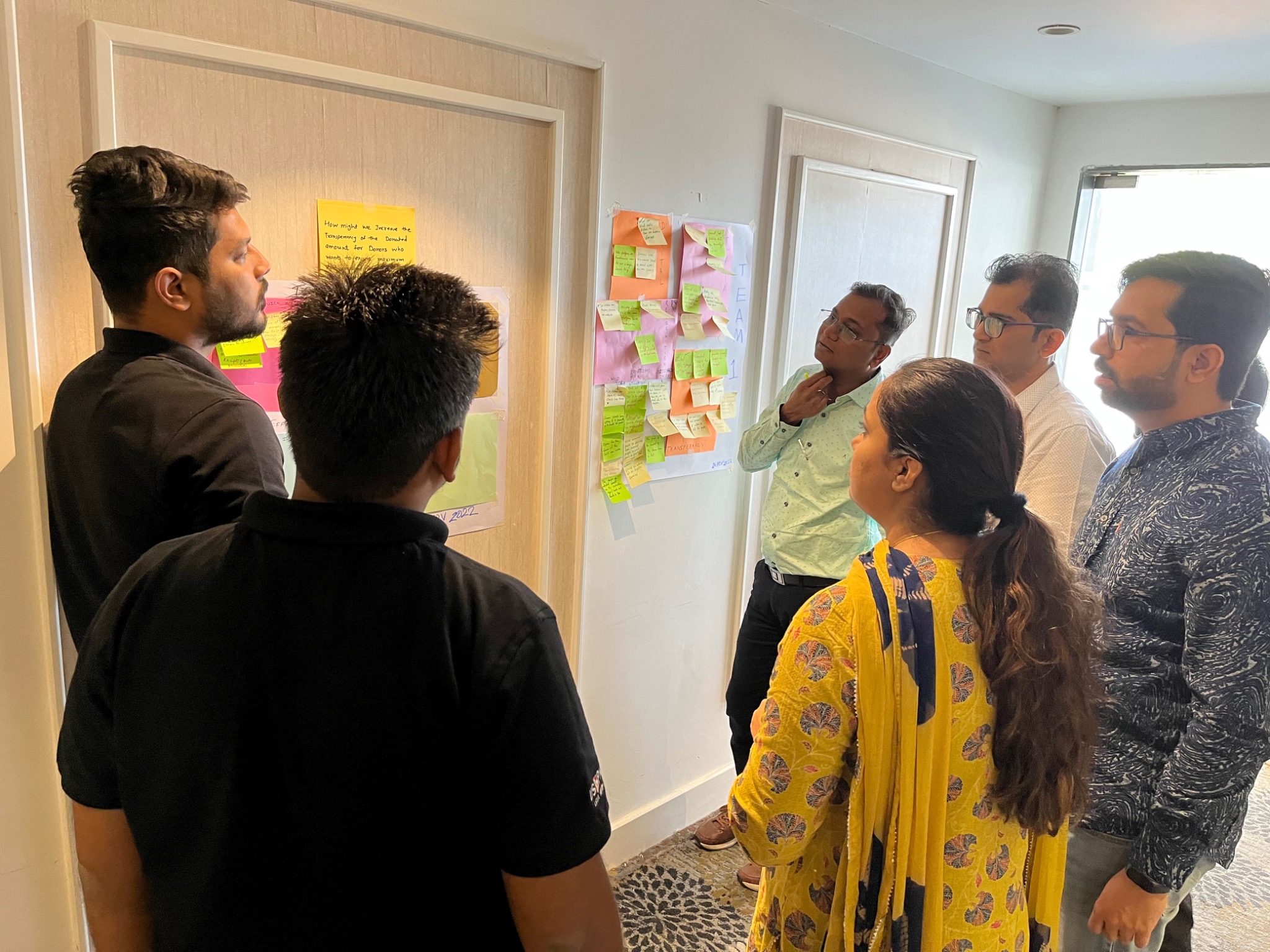
Organisations rarely struggle because their people lack ideas. More often, teams begin developing solutions before they have reached a shared understanding of the problem.
A business issue is presented: customer satisfaction is declining, a process is taking too long, employee engagement needs to improve, a new product is not gaining traction or teams are not adopting a new way of working.
The natural response is to move quickly towards action. A workshop is scheduled, possible solutions are discussed and an implementation plan begins to take shape.
But speed at this stage can be misleading. If the initial problem has been framed too narrowly, every subsequent activity may be focused on improving the wrong thing.
The first description is rarely the complete problem
Consider the statement: “We need to improve employee engagement.” It sounds clear, but it leaves many questions unanswered.
Is the real issue engagement, or is it role clarity? Is it a lack of growth opportunities, poor manager conversations, limited decision-making authority or inconsistent communication during change?
Different employee groups may also experience the organisation very differently. What appears to be one organisation-wide problem may actually be several distinct challenges.
The same applies to customer and operational priorities. “We need a better app” could conceal a fragmented service journey. “We need to automate this process” might overlook unclear policies, duplicate approvals or inconsistent ownership. “We need more innovative ideas” may really mean that employees do not have the confidence, time or leadership support to take ideas forward.
A problem statement is therefore not merely a description. It is a strategic choice about where the organisation will focus its attention.
Poor framing creates expensive consequences
When the problem is framed incorrectly, teams can still appear productive. They conduct meetings, build plans, invest in technology and track progress. However, the work may produce activity without improving the underlying outcome.
Weak problem framing commonly leads to:
- Solutions based on assumptions rather than evidence
- Different teams solving different versions of the problem
- Technology being applied before the process is understood
- Ideas that address symptoms instead of causes
- Limited ownership because affected stakeholders were not involved
- Measures of success that track delivery rather than impact
This is why a technically sound solution can still fail to create meaningful change. The solution may have been well designed. It was simply designed for an incomplete or incorrectly framed problem.
Better framing begins with people and context
Human-centred problem framing starts by understanding who experiences the issue and how it affects them. This requires teams to move beyond internal descriptions and explore the lived experience of customers, employees, partners or other stakeholders.
Useful questions include:
- Who is experiencing the problem?
- What are they trying to accomplish?
- Where does the difficulty occur?
- What evidence supports our current understanding?
- Which assumptions are we treating as facts?
- What has already been tried?
- What organisational conditions may be contributing to the issue?
- What would a better outcome look like for the people affected?
These questions often reveal that the visible problem is only one part of a broader system.
A delayed customer response may involve technology, but it may also involve unclear decision rights and multiple handovers. Low participation in an innovation programme may reflect employee capability, but it may also indicate that leaders do not create the space or psychological safety required for experimentation.
Framing is not about delaying action
Problem framing is sometimes misunderstood as a long research exercise. It does not need to be. The objective is to develop enough shared understanding and evidence to make the next action more intelligent.
A focused framing process can help teams:
- Clarify the business context and intended outcome
- Identify the people and stakeholders affected
- Gather relevant observations and evidence
- Separate facts from assumptions
- Recognise patterns, tensions and unmet needs
- Reframe the initial challenge
- Define a focused opportunity for action
A well-framed challenge gives teams direction without prescribing the solution.
For example, “How might we help new managers hold more useful development conversations with their teams?” creates a more focused area for exploration than “How can we improve employee engagement?”
The second statement describes a broad organisational ambition. The first identifies a specific human and organisational opportunity that can be explored, tested and measured.
Leadership plays a critical role
Better framing is not only the responsibility of innovation teams or facilitators. Leaders shape the quality of problem solving through the questions they ask and the behaviours they reward.
When leaders arrive with a predetermined answer, teams are likely to validate it rather than investigate the problem openly. When leaders encourage curiosity, evidence and constructive challenge, teams are more willing to revisit assumptions and identify what is actually happening.
This does not mean leaders should avoid making decisions. It means they should distinguish between situations that require immediate execution and those that require deeper understanding before action.
One of the most useful leadership questions is: “What would need to be true for our current understanding of this problem to be correct?” It makes assumptions visible and opens the conversation to evidence.
From better framing to better outcomes
Better problem framing improves more than the quality of ideas. It creates shared clarity across functions, strengthens stakeholder ownership and provides a stronger basis for prioritisation.
It also makes experimentation more meaningful. Teams can test whether a proposed solution improves the specific outcome they are trying to influence, rather than merely checking whether the solution can be delivered.
The result is a clearer progression:
Human insight → focused problem → relevant ideas → evidence → informed decisions → measurable outcomes
This is central to how Design Thinking contributes to business performance. Its value is not limited to creativity or ideation. It helps organisations understand the right problem before investing heavily in the solution.
A practical starting point
Before beginning the next transformation initiative, process redesign or innovation programme, pause and ask: “Are we solving the problem as it was initially presented, or the problem as people actually experience it?”
That distinction can change the direction of the entire initiative.
Better outcomes do not begin with more ideas. They begin with a better understanding of where to focus.