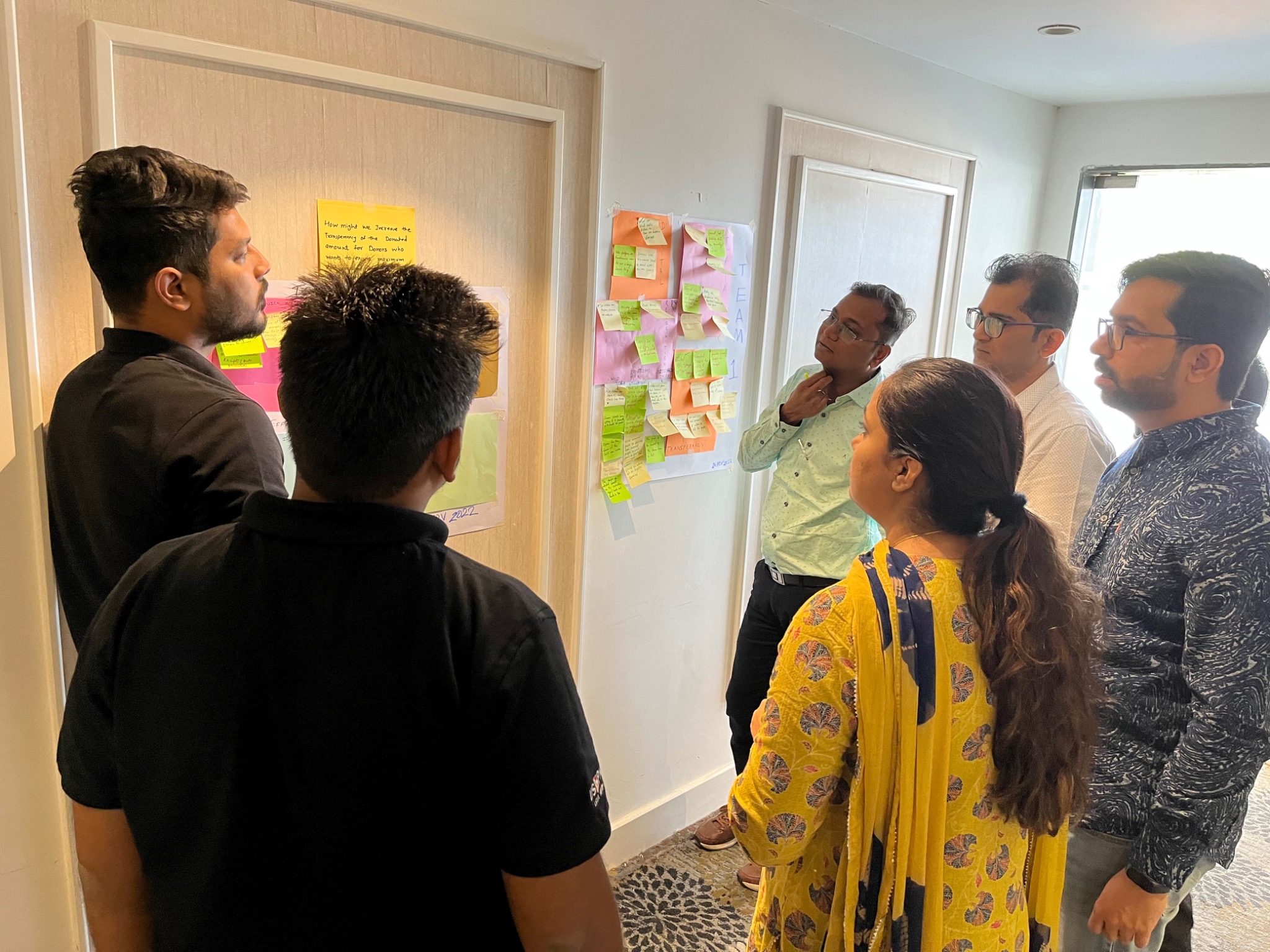
Many organisations begin their innovation journey by introducing tools, running workshops or asking teams to generate more ideas. These activities can create energy. But they do not always create lasting innovation capability.
The underlying challenge is often not a shortage of ideas or creativity. It is a lack of alignment between the people expected to innovate, the processes they follow, the behaviours encouraged by the organisation and the signals sent by leadership.
Before prescribing an innovation programme, it is useful to understand this underlying system. That is why our Strategic Foundations of Innovation work begins with a diagnostic conversation.
Innovation capability is shaped by more than tools
Design Thinking, Lean experimentation and Agile ways of working can help teams understand problems, test assumptions and move ideas forward.
However, methods alone cannot compensate for an organisational environment that makes innovation difficult.
- A team may be trained in Design Thinking but still be unable to speak with customers.
- Employees may be invited to submit ideas, but see little evidence of decisions or follow-through.
- Leaders may encourage experimentation while continuing to reward only certainty and short-term delivery.
- Pilot projects may generate promising results, but lack ownership, funding or a route to scale.
These are not training gaps alone. They are signs of an organisation's Innovation DNA.
What do we mean by Innovation DNA?
Innovation DNA describes the underlying patterns that influence how an organisation identifies problems, develops ideas, tests possibilities and translates opportunities into results.
Our Innovation DNA Canvas examines four connected strands.
1. People DNA
Who is empowered to identify problems, contribute ideas and collaborate across organisational boundaries? This includes participation, psychological safety, diversity of perspectives and the ability to involve the people affected by a problem.
2. Process DNA
How are problems framed, explored and validated? This considers whether teams begin with evidence and human insight, or move directly towards familiar solutions. It also examines how ideas are tested, prioritised and taken towards implementation.
3. Culture DNA
Which behaviours are genuinely encouraged, recognised or discouraged? Innovation culture is not created through a campaign or slogan. It develops through small, repeatable and consistent habits - how questions are received, how mistakes are treated and whether teams have permission to challenge assumptions.
4. Leadership DNA
What do leaders signal through their decisions and actions? Leadership support becomes visible through the priorities leaders set, the questions they ask, the resources they provide and their willingness to act on evidence that challenges an existing view.
Assess the reality, not the intention
The Innovation DNA Canvas is designed to support an honest, evidence-led conversation. Participants assess the organisation's current reality rather than its stated ambition. Each assessment must be supported by examples from actual work.
An organisation may describe itself as collaborative, but important decisions may still be taken within functional silos. It may value customer centricity, but teams may rarely engage directly with customers. It may encourage experimentation, but require every initiative to demonstrate certainty before a small test can begin.
The diagnostic is therefore not about producing an attractive score. It is about revealing the patterns that influence everyday behaviour.
Recognising the dominant pattern
When the four strands are considered together, organisations often recognise one or more dominant patterns:
- Innovation remains limited to incremental improvement.
- Teams operate reactively and solve immediate problems.
- Innovation is driven primarily from the top.
- Experiments take place, but successful ideas do not scale.
- Strong ideas lose momentum before decisions are made.
- Ideas move consistently from insight to measurable impact.
Recognising the pattern helps explain why apparently strong innovation efforts may not be producing the expected outcome.
For example, an organisation may have enthusiastic people and a structured innovation process, but limited leadership sponsorship. Teams can generate and validate ideas, yet struggle to secure decisions.
Another organisation may have committed leaders but weak problem-framing practices. Initiatives move quickly, but they may be solving the wrong problem.
Connecting the diagnostic with Strategic Foundations of Innovation
Strategic Foundations of Innovation is not positioned as a predetermined workshop. It is a consulting-led capability journey shaped around the organisation's context, business model and priorities.
The Innovation DNA diagnostic helps establish the starting point. It informs decisions about:
- The business challenges that should anchor the engagement.
- The behaviours and capabilities that require attention.
- The leaders and stakeholders who need to participate.
- The combination of Design Thinking, Lean and Agile practices required.
- The obstacles that could prevent ideas from progressing.
- The evidence that will demonstrate meaningful progress.
A GCC, for example, may want to move from efficient service delivery towards greater ownership, innovation and strategic contribution.
A consumer business may be focused on customer experience, new propositions, pricing or market growth. A shared-services organisation may need to redesign processes, improve employee experience or identify automation and AI opportunities.
The methods may be similar, but the required capability shift is different.
From diagnosis to a 90-day shift
A diagnostic is only useful if it leads to action.
Instead of attempting to change every aspect of the organisation at once, the Innovation DNA Canvas helps teams identify one critical shift with the greatest immediate leverage.
That shift might involve:
- Giving frontline teams a structured way to frame recurring customer problems.
- Introducing evidence-based reviews before approving solutions.
- Creating a regular rhythm for testing and reviewing ideas.
- Strengthening leadership sponsorship for cross-functional initiatives.
- Establishing clear ownership for moving validated ideas towards implementation.
- Creating space for reflection, learning and adaptation.
The chosen action should be concrete and testable within approximately 90 days. The organisation should also define what success would look and feel like in practice. This moves the conversation from broad aspiration to observable behaviour.
Building capability through real work
Innovation capability is not built by teaching tools in isolation. It develops when people apply new ways of working to live business priorities, receive coaching, gather evidence and reflect on what happened.
Our Strategic Foundations of Innovation engagements therefore combine:
- Diagnostic and discovery conversations.
- Leadership alignment.
- Applied learning using real organisational challenges.
- Design Thinking and human-centred problem framing.
- Lean experimentation and evidence gathering.
- Agile ways of working where adaptable execution is required.
- Coaching between sessions.
- Review of progress and measurable learning.
The objective is not simply to complete an innovation workshop. It is to help the organisation develop a repeatable ability to move from unclear problems to focused action and measurable impact.
The diagnostic is a starting point, not a verdict
An Innovation DNA diagnostic is not intended to label an organisation as innovative or non-innovative.
Every organisation has existing strengths, constraints and pockets of effective practice. The diagnostic helps make these visible so that leaders can decide what to strengthen, what to connect and what to change.
It also creates a common language across leadership, functions and teams. That shared understanding is often the first step towards building an innovation culture grounded in everyday work rather than isolated initiatives.
Innovation does not usually fail because people lack ideas. It struggles when People, Process, Culture and Leadership pull in different directions.
Building innovation capability begins by understanding that system - and then making one deliberate, evidence-led shift at a time.