Organisations often say they want people to develop an innovation mindset.
The expectation is understandable. They want people to be more curious, challenge established ways of working, collaborate across boundaries and respond confidently to change.
But the phrase can become vague.
Is an innovation mindset something a person naturally possesses? Is it created through an inspiring workshop? Does it mean generating more ideas or simply becoming more open to change?
An innovation mindset becomes meaningful only when it can be seen in how people approach real work. It is not a personality trait. It is a set of behaviours that can be learned, practised and strengthened over time.
Mindset is revealed through behaviour
People may describe themselves as innovative, customer-focused or open-minded. The more useful question is how these intentions influence their actions.
An innovation mindset becomes visible when people:
- Remain curious before reaching a conclusion
- Seek evidence instead of defending assumptions
- Understand the experiences of customers, employees and stakeholders
- Reframe a problem when new information emerges
- Explore more than one possible response
- Test an idea before making a large commitment
- Work across functional boundaries
- Learn from results without treating every setback as failure
- Take ownership of the next step
These are not abstract qualities. They are observable behaviours. When people practise them consistently, mindset begins to develop into capability.
Mindset without capability creates intention, not progress
A positive attitude towards innovation is useful, but it is not sufficient.
A team may be enthusiastic about trying something new but still struggle to understand the problem, conduct useful research, interpret evidence or decide which idea should move forward.
Mindset provides the willingness to approach the work differently. Capability provides the methods, judgement and confidence required to do it. The two need to develop together.
Curiosity encourages a team to ask better questions. Design Thinking provides practical ways to investigate the experiences and needs of the people affected.
Openness to experimentation creates willingness to test an idea. Prototyping provides a structured way to expose assumptions before significant investment.
A desire for collaboration brings people together. Facilitation and stakeholder-mapping methods help them understand different perspectives and work towards a shared outcome.
Six behaviours that strengthen an innovation mindset
1. Curiosity before certainty
Teams often move quickly towards solutions because they believe they already understand the problem. Curiosity creates a pause. It encourages people to ask what they may be missing, whose experience has not been considered and what evidence could challenge the current understanding.
2. Empathy beyond assumptions
Empathy is not simply being considerate. In innovation work, it means making a disciplined effort to understand how another person experiences a situation. An innovation mindset recognises that internal knowledge is not a substitute for direct understanding.
3. Reframing before solving
The first description of a problem is not always the most useful one. What initially appears to be a technology problem may be an experience problem. An engagement issue may have its roots in everyday processes or leadership behaviour. Reframing helps teams work on the problem that deserves attention.
4. Experimentation before commitment
Innovation work frequently begins with uncertainty. An experimentation mindset does not remove discipline. Instead of building the complete solution immediately, teams identify the assumptions that matter most and find practical ways to test them.
5. Collaboration beyond functional boundaries
Many business challenges sit between functions. No single team sees the complete situation. An innovation mindset encourages people to move beyond protecting functional positions and build a shared understanding of the outcome.
6. Ownership beyond ideation
Generating an idea is not the same as owning its progress. Ownership becomes visible when teams clarify the next action, engage stakeholders, gather evidence, test assumptions and ask leaders for specific decisions.
Design Thinking helps people practise the mindset
Design Thinking is often introduced as a process or a collection of tools. Its greater value lies in the behaviours it repeatedly asks people to practise.
Understanding users develops curiosity and empathy. Synthesising research develops the ability to recognise patterns and challenge assumptions. Framing a point of view develops clarity. Generating alternatives expands thinking. Prototyping builds comfort with experimentation. Testing encourages learning from evidence.
The tools matter, but the repeated behaviours behind the tools are what begin to change how people approach work.
Real business problems make the learning credible
Mindset cannot be developed only through classroom discussion. People need to apply the behaviours when the situation is unclear, stakeholders disagree and operational constraints are real.
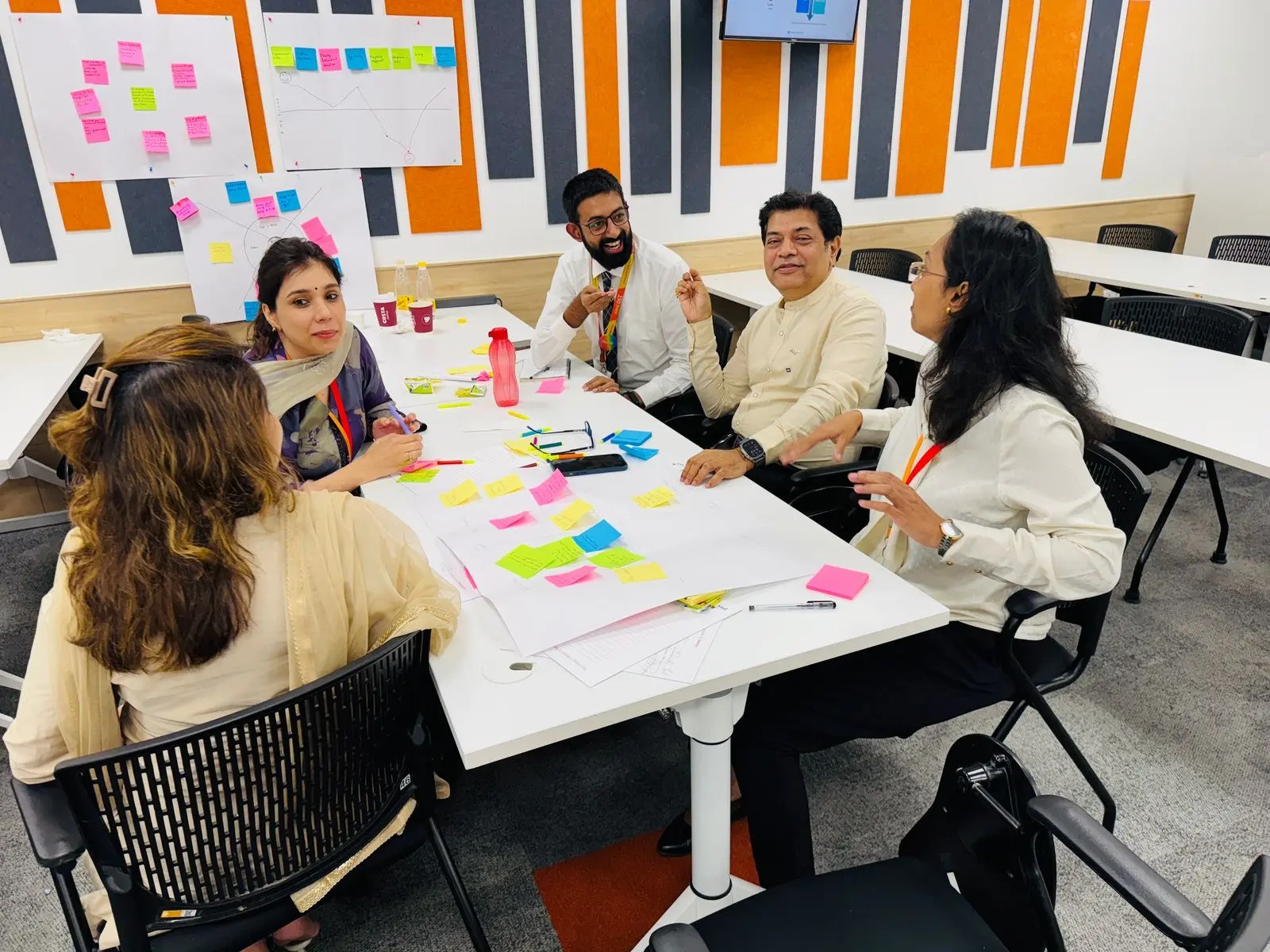
This is why Innovation Spark Asia uses live business challenges in its Design Thinking Labs and capability programmes.
Teams do not simply discuss curiosity, experimentation or ownership. They must demonstrate these behaviours while working on a customer, employee, process, product or organisational priority.
The difficulty of the work is part of the learning. Participants begin to understand that an innovation mindset is not about being endlessly creative or optimistic. It is about approaching uncertainty with discipline.
Coaching helps new behaviours become repeatable
A workshop can create awareness and give teams an initial experience of working differently. The real challenge is sustaining those behaviours after the facilitated sessions have ended.
Under time pressure, people can return to familiar habits. Teams may begin discussing solutions before gathering evidence. Stakeholders may be involved too late. Prototypes may be treated as finished answers rather than learning tools.
Innovation Spark Asia can provide 6–12 weeks of coaching and mentoring to help teams apply the mindset and methods to live work.
The role of coaching is not to take over the problem. It is to help teams recognise their assumptions, maintain the discipline of the approach and develop confidence in their own judgement. Repeated application is what begins to turn a new behaviour into a working habit.
Organisational conditions shape individual mindset
It is easy to ask employees to become more innovative while leaving the surrounding conditions unchanged.
People are unlikely to experiment if every unsuccessful test is treated as failure. They will hesitate to challenge assumptions if seniority always determines the answer. Cross-functional collaboration will remain difficult if teams are measured only on departmental goals.
Leaders can reinforce innovation mindset by asking what evidence supports a recommendation, encouraging teams to explore the problem before presenting solutions, making space for small experiments, reviewing learning as well as outcomes, involving stakeholders earlier and rewarding ownership and collaboration.
Mindset is personal, but it is also shaped by the system in which people work.
From individual behaviour to organisational capability
An innovation mindset becomes an organisational capability when the behaviours are no longer dependent on a few enthusiastic individuals.
Teams begin to use a shared approach to investigate problems. Leaders ask consistent questions. Functions collaborate earlier. Ideas are tested before large investments are made. Evidence becomes part of decision-making.
Innovation mindset is built through use
An innovation mindset cannot be installed through a presentation or declared through a value statement. It develops when people are given the opportunity, methods and support to practise new behaviours on work that matters.
The objective is not to turn everyone into an innovation specialist. It is to help people across the organisation become more capable of understanding complex problems, challenging assumptions, learning through evidence and taking focused action.
That is when mindset moves beyond intention. It becomes a practical capability that helps the organisation respond to change, solve meaningful problems and create measurable progress.