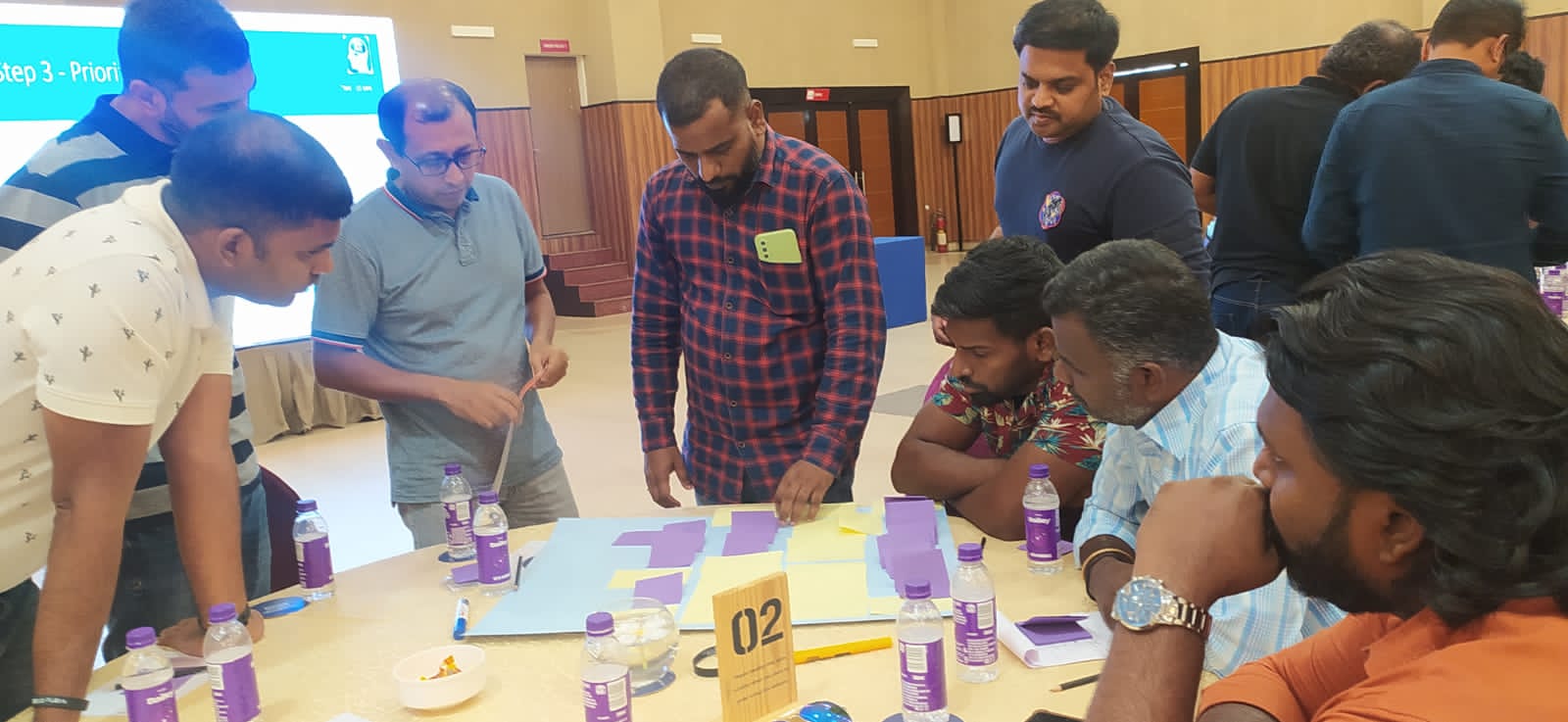
Corporate Design Thinking workshops often begin with visible energy. Participants collaborate across functions, challenge assumptions and develop ideas that may not have emerged in routine meetings. That matters. But a good workshop should not be judged only by what happens in the room.
The workshop is a starting point
A workshop creates the conditions for focused work. It gives people time, structure and permission to examine a challenge from the perspective of customers, employees or other stakeholders. It can also create a shared language across teams that normally approach the same issue differently.
Those are useful foundations. They do not, by themselves, change how an organisation makes decisions or acts on evidence. If the ideas are disconnected from business priorities, ownership and follow-through, the energy fades quickly.
Real business challenges change the quality of learning
Design Thinking is easier to understand when participants use it on a live priority rather than a classroom exercise. Real work introduces the constraints that matter: competing stakeholders, incomplete evidence, operating pressures, legacy processes and decisions that require leadership support.
When teams work with that complexity, the methods stop feeling like workshop tools. They become a practical way to understand the problem, question assumptions and create options that fit the organisation's context.
Ideas need to become decision-ready
Generating ideas is rarely the hardest part. The challenge is helping teams decide which ideas deserve further attention, what evidence is still missing and what can be tested before significant time or money is committed.
A well-designed programme therefore moves beyond ideation. It helps teams make concepts visible, identify assumptions, gather feedback and define focused next actions. The intended output is not a wall of ideas. It is clearer direction and stronger decisions.
Leadership involvement matters
Teams can do thoughtful work and still struggle to move forward if sponsors appear only at the beginning or end. Leadership involvement helps connect the challenge to strategic priorities, clarifies the boundaries within which teams can act and creates a route for timely decisions.
This does not mean leaders should control the workshop. It means they should help establish the purpose, remain accessible when important questions arise and engage seriously with the evidence and recommendations that emerge.
Capability develops through repeated application
One workshop can introduce a useful way of thinking. Capability develops when people apply it repeatedly, reflect on what worked and adapt the methods to different situations.
Coaching between sessions, practical playbooks, peer review and follow-up working sessions can help teams use the approach after the facilitated experience ends. Over time, small repeatable habits - starting with stakeholders, framing the problem, testing assumptions and learning before scaling - can strengthen a wider culture of innovation.
What should a well-designed corporate programme include?
Before the workshop
- A clearly defined business priority and intended outcome
- The right mix of participants and decision-makers
- Existing evidence, stakeholder perspectives and known constraints
- Sponsor alignment on what may happen after the workshop
During the workshop
- Work on a live challenge rather than a generic simulation
- Structured problem framing and stakeholder understanding
- Space for divergent thinking without losing business focus
- Concept development, testing and prioritisation
- Clear ownership of immediate next actions
After the workshop
- Follow-up coaching or working sessions
- Further evidence gathering and validation
- Leadership review at the right decision points
- Practical support to move promising concepts forward
- Reflection that helps participants reuse the approach elsewhere
Positive feedback matters - but it is not the final measure
Participant feedback can tell us whether a programme felt relevant, useful and well facilitated. Recent anonymised corporate cohorts in the Philippines and Dubai provide strong signals on that experience.
rated topic usefulness 4 or 5 out of 5, based on 17 complete responses.
for relevance and quality, with full participation and a Net Promoter Score of 94.
These measures are encouraging, but they are not the same as business impact. The more important questions come later: Did teams use the methods again? Did the evidence change a decision? Did a concept progress? Did leaders create space for new behaviours to continue?
From workshop activity to organisational capability
The value of Design Thinking is not that it makes workshops more creative. It is that it can help organisations understand the right problems, bring different perspectives together and make better choices under uncertainty.
That value grows when the workshop is treated as one part of a wider journey - connected to strategy, real work, leadership and repeated application. The goal is not to run more workshops. It is to help people and organisations develop a more human-centred and evidence-led way of moving from challenge to action.