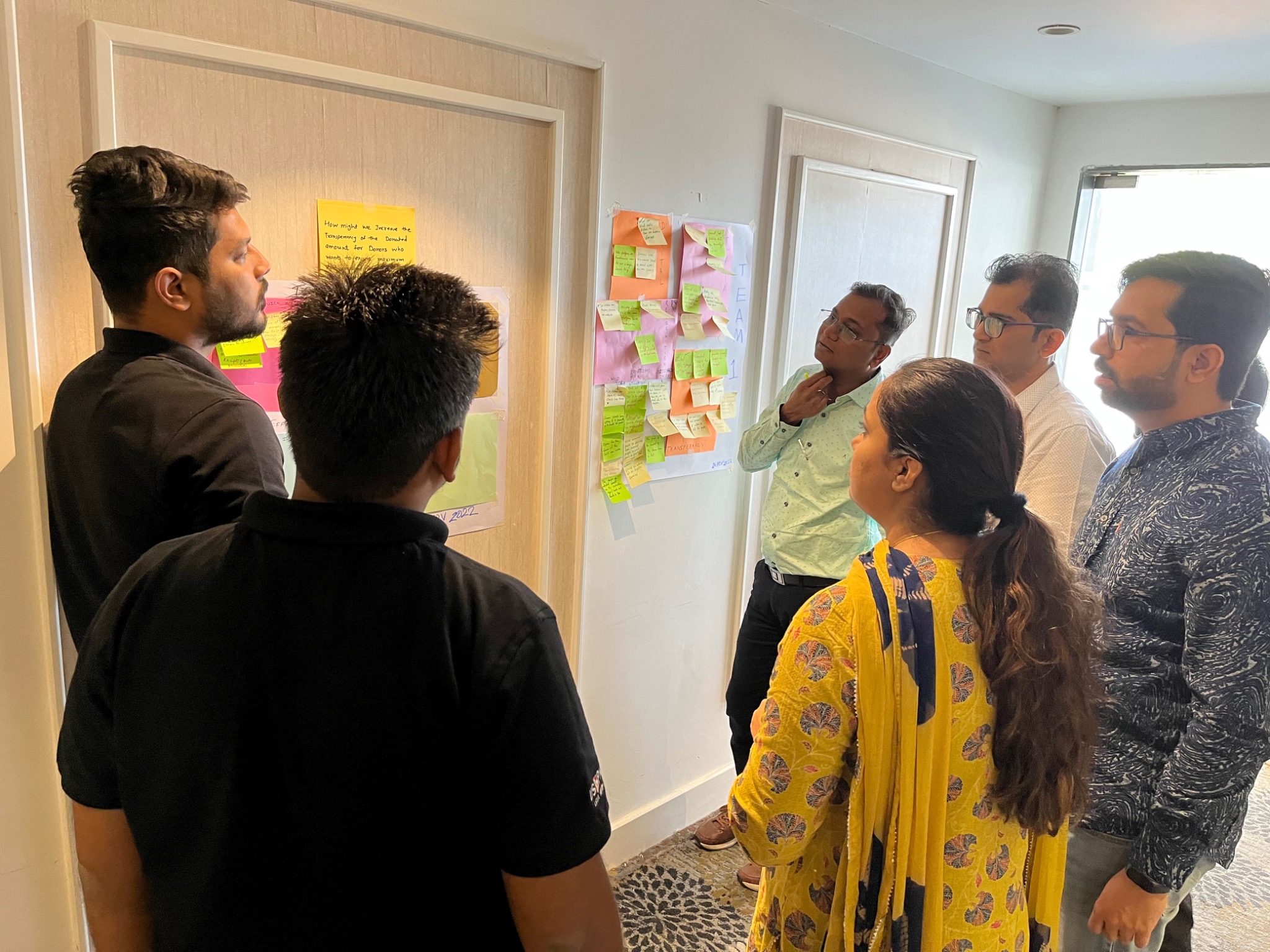
Most organisations say they are customer-focused. Customer-centricity appears in strategy documents, leadership messages and values statements. Yet many employees rarely meet a customer, hear a customer conversation or see how their daily decisions affect the customer experience.
This creates a gap between the organisation's stated intent and the way work is actually done.
A customer-first culture is not built by repeating the word customer. It is built when people consistently use customer understanding to shape priorities, processes and decisions.
Customer-first is a way of making decisions
Being customer-first does not mean agreeing to every customer request. It means understanding the customer's situation before deciding what the organisation should do.
It changes the questions teams ask:
- Who is affected by this decision?
- What are they trying to achieve?
- Where does the current experience create effort, confusion or delay?
- What evidence do we have beyond our internal assumptions?
- How will the proposed change improve an outcome that matters?
These questions help organisations connect internal activity with external value.
The customer is often missing from internal conversations
Many business discussions begin with systems, policies, targets and functional constraints. Those considerations are important, but when they dominate the conversation, teams can optimise an internal process while making the customer experience harder.
The customer's perspective is especially easy to lose in large organisations. Work passes through multiple functions, and each team sees only one part of the experience. No single team intends to create friction, but the combined result may still be slow, confusing or inconsistent.
A customer-first approach makes the complete experience visible before individual functions begin improving their own piece.
Employees do not need to meet every customer to think customer-first
Customer-first culture is not limited to frontline roles. Finance, HR, technology, operations, risk and shared-service teams all make decisions that affect customers directly or indirectly.
Employees can build customer understanding through interviews, observation, complaints, service data, journey maps, frontline conversations and feedback from internal stakeholders. The purpose is not to create more research. It is to bring relevant evidence into everyday decisions.
When people understand the experience their work creates, their role becomes clearer and their choices become more deliberate.
Design Thinking makes the customer visible
Design Thinking provides a practical way to bring human insight into problem solving. It encourages teams to understand the people affected, frame the right problem, explore alternatives and test assumptions before making large commitments.
Used well, it helps teams move beyond opinions and internal preferences. It creates a shared view of the experience and gives different functions a common basis for action.
Design Thinking is not valuable because it produces colourful artefacts. It is valuable because it improves the quality of the problem, the evidence and the decisions that follow.
From customer insight to focused action
1. Understand the experience
Listen to customers and the employees who support them. Observe what happens, not only what the process says should happen.
2. Identify the points that matter
Find the moments that create the greatest effort, uncertainty or loss of trust. Not every issue has equal importance.
3. Reframe the problem
Separate the visible symptom from the underlying need. A request for a new system may point to unclear information, fragmented ownership or a poorly designed process.
4. Develop and test alternatives
Explore more than one response and test the riskiest assumptions on a manageable scale.
5. Define ownership and measures
Agree who will act, what will change and how progress will be measured. Insight creates value only when it leads to a decision.
Culture develops through small, repeatable habits
Culture often feels abstract because organisations try to change it through broad messages. In practice, culture is reinforced through repeated behaviour.
Customer-first habits can be simple:
- Begin reviews with the customer or stakeholder outcome
- Include customer evidence in business cases
- Ask what assumption is being made before approving a solution
- Invite frontline colleagues into process redesign
- Test an idea before scaling it
- Review whether a change improved the experience, not only internal efficiency
- Share what was learned across functions
Individually, these actions may appear small. Repeated consistently, they change how the organisation thinks and works.
Leadership behaviour determines what continues
Employees notice what leaders ask about, reward and challenge. If leaders speak about customers but review only cost, speed and compliance, teams will understand what really matters.
Leaders strengthen customer-first culture when they ask for evidence, protect time for understanding the problem and recognise teams that learn before they scale. They also create permission to surface inconvenient insights rather than presenting only positive information.
The strongest signal is not a speech. It is the quality of the questions leaders ask when a decision is being made.
Customer-first culture requires cross-functional ownership
Customers experience the organisation as one system, even when the work is divided across many functions. A problem that appears in one touchpoint may have causes elsewhere.
Cross-functional work is therefore essential. Teams need shared evidence, a common problem statement and clarity about the outcome they are trying to improve. This moves the conversation away from defending individual functions and towards improving the complete experience.
Workshops can start the journey, but they cannot complete it
A Design Thinking workshop can create shared language, expose assumptions and help teams develop a more useful response. But a workshop alone does not create a customer-first culture.
The work must continue through coaching, experiments, leadership reviews and repeated application to live priorities. Teams need opportunities to use the approach until it becomes part of how they work rather than something they experienced once.
The real test of a customer-first culture
The test is not whether employees can explain a customer journey map or name the stages of Design Thinking.
The test is whether customer understanding changes a decision.
Did the team reframe the problem? Did it stop an unnecessary solution? Did it simplify an experience? Did it test an assumption before investing? Did different functions take shared ownership? Did leaders act on the evidence?
These are the signs that customer-first thinking is becoming part of the culture.
Better understanding leads to better decisions
Customer-first culture is not a separate initiative. It is a discipline that improves strategy, innovation, process design, employee engagement and execution.
When organisations make the customer visible, use human insight to frame problems and reinforce small, repeatable habits, customer focus becomes more than an aspiration.
It becomes a practical way of making better decisions.