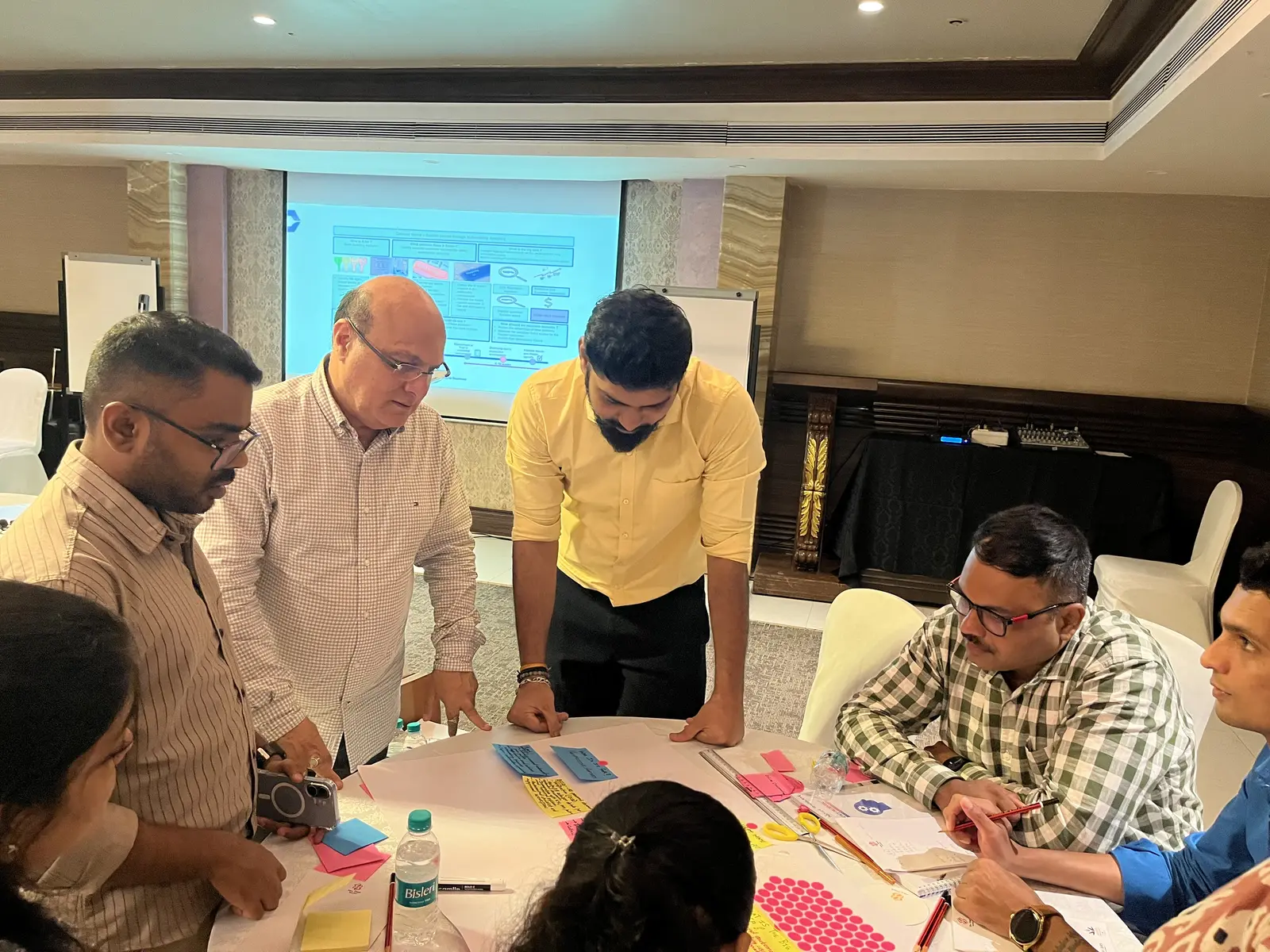
Most leadership challenges do not arrive with a clearly defined problem, complete information and an obvious answer.
They emerge through changing customer expectations, competing priorities, organisational dependencies and stakeholders who see the situation differently.
Leaders are still expected to create direction and mobilise action. But traditional problem-solving approaches can be difficult to apply when the problem itself remains uncertain.
This is where Design Thinking becomes more than a method for developing products or running workshops. It becomes a practical leadership capability for navigating ambiguity, building shared understanding and taking ownership of progress.
Ambiguity is not the same as a lack of information
When faced with uncertainty, the natural response is often to request more data.
Additional information can help, but ambiguity is not always caused by missing data. It may exist because stakeholders interpret the situation differently, customer needs are evolving, the boundaries of the problem are unclear or several possible outcomes appear equally valid.
In these situations, leaders cannot wait until every question has been answered. They need a disciplined way to move forward without pretending that certainty already exists.
Design Thinking helps leaders investigate the situation, understand different perspectives and convert uncertainty into questions that teams can explore.
Leadership begins with framing the right problem
Leaders are frequently presented with problems that already contain an assumed solution:
- We need a new technology platform.
- Employees require another engagement initiative.
- Customers need a digital channel.
- The team needs Agile training.
- The process needs greater automation.
Each statement may point towards a legitimate opportunity. But acting immediately can lock the organisation into a solution before the underlying need has been understood.
A Design Thinking mindset encourages leaders to pause and ask who is experiencing the problem, what evidence exists, which assumptions are shaping the interpretation and what a meaningful outcome would look like.
Empathy strengthens leadership judgement
Empathy is sometimes misunderstood as being agreeable or trying to satisfy everyone.
In leadership, empathy is the discipline of understanding how a decision, process or organisational priority is experienced by the people affected by it. That can include customers, employees, business partners, operational teams, regulators and leaders in other functions.
Understanding these perspectives does not remove the need to make difficult choices. It improves the quality of those choices.
Human insight complements commercial, operational and technical information. It does not replace them.
Ownership starts when the problem is no longer someone else's
Complex challenges often cross organisational boundaries. Customer experience may involve technology, operations, sales and service. Employee experience may involve HR, managers, workplace systems and organisational policies.
When ownership is defined only through departmental boundaries, people can recognise a problem without feeling responsible for changing it.
Design Thinking brings stakeholders around a shared challenge. The conversation begins to shift from defending functions to understanding the outcome, from explaining constraints to exploring possibilities, and from general agreement to clear ownership of the next step.
Ownership does not mean solving everything personally. It means accepting responsibility for creating movement.
Leaders need to create clarity without prescribing every answer
In uncertain situations, teams need direction. But excessive prescription can limit the insight and expertise available within the organisation.
Leaders can create clarity by defining the business priority, the people affected, the intended outcome, important constraints, the decisions the team can make and the evidence required for further investment.
This gives teams a clear frame while allowing them to investigate the problem and develop possible responses. The leader remains accountable for direction and decisions without controlling every action.
Experimentation makes uncertainty manageable
Organisations sometimes treat experimentation as a creative exercise that happens separately from serious business decisions. In reality, experimentation is a disciplined way to manage risk.
- What must be true for this idea to work?
- Which assumption presents the greatest risk?
- What is the smallest useful test?
- What evidence would increase our confidence?
- What would cause us to change direction?
This breaks a large uncertain decision into smaller learning steps. The objective is not to avoid decisions. It is to make better decisions with the evidence available.
Evidence should change the conversation
Leadership discussions can become dominated by hierarchy, confidence and personal preference.
Design Thinking introduces observable evidence from customers, employees, stakeholders and experiments. This gives teams something more useful to discuss than competing opinions.
An evidence-led leader can acknowledge that an assumption was incorrect, adapt an option, ask for more learning, stop an idea or move forward with greater confidence.
Collaboration requires more than stakeholder participation
Inviting multiple functions into a meeting does not automatically create collaboration. People may attend while continuing to protect functional priorities, wait for senior direction or avoid responsibility for difficult trade-offs.
Design Thinking gives cross-functional teams a shared process for understanding the challenge, making assumptions visible and developing evidence together.
Stakeholders are not simply asked for their opinions. They help build a common understanding of the situation and contribute to the next decision.
Leaders must make the next decision clear
Innovation initiatives often lose momentum because teams finish a workshop or present an idea without knowing what decision is required. "Take this forward" is too vague.
A useful decision may involve approving a small experiment, providing access to customers, assigning an owner, resolving a dependency, making data available, allocating resources for validation or stopping an idea.
Leaders create momentum when they make these decisions explicit and explain what evidence will be needed at the next stage.
Design Thinking develops leaders through real work
Leadership capability is not built through concepts alone. People develop confidence when they apply new behaviours to important situations, receive feedback and reflect on what happened.
Live business priorities help leaders practise listening without immediately proposing a solution, reframing unclear challenges, working across boundaries, testing ideas, using evidence and taking ownership of the next step.
The business challenge becomes both the work to be addressed and the environment in which leadership capability is developed.
The leader's role changes with the work
Different situations require different forms of leadership. At times, the leader must provide direction. At other times, the leader must facilitate understanding, coach the team, remove an organisational barrier or make a difficult decision.
Design Thinking does not prescribe one leadership style. It helps leaders recognise what the situation requires and move between these roles with greater intention.
From ambiguity to responsible action
Leadership in ambiguity does not mean having every answer. It means helping people understand the situation, frame a useful challenge and take the next responsible action despite incomplete information.
Design Thinking supports this by giving leaders a structured way to listen, question assumptions, collaborate, experiment and learn.
Most importantly, it turns ambiguity from a reason to delay into an opportunity to build clarity through action.
That is why Design Thinking should not be seen only as an innovation methodology. It is a leadership capability for creating direction, strengthening ownership and making better decisions when the path is not yet clear.