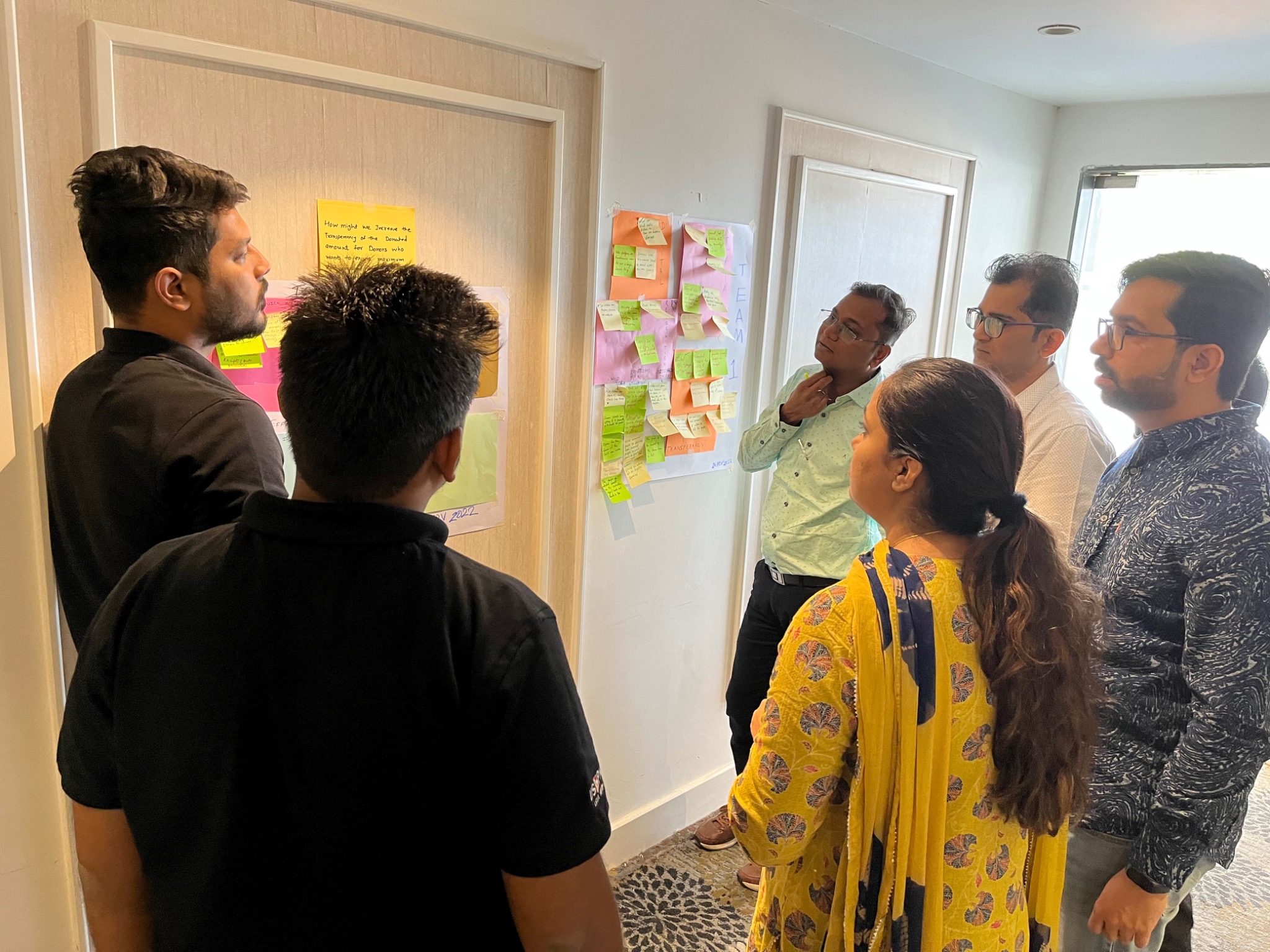
Most organisations do not struggle to generate ideas. Put a diverse group of people around a meaningful challenge and the room will quickly fill with possibilities.
Workshops can create energy, participation and optimism. Teams see new opportunities and leaders hear perspectives that are often missing from day-to-day work.
But the real test begins after the workshop. Which ideas deserve attention? What evidence supports them? Who owns the next step? What decision is required? Without a clear pathway, even strong ideas return to presentations, parking lots and forgotten action trackers.
Generating ideas creates energy, not progress
Ideation is valuable because it expands the range of possible responses to a challenge. It helps teams move beyond the first obvious answer and combine different perspectives.
However, the number of ideas is not a useful measure of innovation. A wall covered in sticky notes may show participation, but it does not show whether the organisation is closer to a better decision or outcome.
Good ideas often enter an organisational gap
Promising ideas frequently sit between existing structures. They may require cooperation across functions, a new owner, access to customers, leadership sponsorship or a small amount of funding to test an assumption.
When these conditions are unclear, momentum fades. Everyone may support the idea, yet nobody has the authority or responsibility to move it forward.
This is why innovation needs more than creativity. It needs a repeatable route from insight to action.
Begin by validating the problem
Before developing a solution, teams should confirm that the problem is real, relevant and understood well enough to act upon.
- Who experiences the problem?
- What is happening in their current context?
- What evidence shows the scale or importance of the issue?
- What assumptions are we making?
- What would improve if the problem were addressed?
A compelling idea built around a weak understanding of the problem is unlikely to create meaningful value.
Turn the idea into a clear concept
An idea becomes easier to evaluate when it is expressed as more than a short label. A clear concept should explain the user or stakeholder, the need being addressed, the proposed response, the expected value and the assumptions that must be tested.
This creates a shared reference point. It also helps leaders and colleagues provide useful challenge rather than react to an idea that different people interpret differently.
Prototype to learn, not to impress
Teams sometimes wait until an idea looks polished before sharing it. That increases the cost of change and can encourage people to defend the solution rather than learn from feedback.
A prototype can be a sketch, storyboard, role-play, process mock-up, sample communication or a small operational experiment. Its purpose is to make an assumption testable.
Evaluate more than desirability
Customer or employee interest matters, but it is not enough. Teams should consider whether an idea is desirable for the people affected, feasible within the organisation, viable in relation to value and resources, aligned with strategy and responsible in its wider impact.
The objective is not to eliminate uncertainty. It is to identify the most important uncertainty and reduce it enough to support a sensible decision.
Make the next decision explicit
Ideas often stall because the required decision remains vague. "Take this forward" is not a decision.
A useful next step might be permission to interview customers, approval for a short experiment, access to operational data, nomination of a cross-functional owner, a leadership review or a decision to stop.
When the next decision is explicit, the team can gather the evidence needed for that decision rather than produce a large business case too early.
Ownership cannot remain with the workshop
The facilitator can help teams frame the challenge, develop concepts and design experiments. But ownership must sit with people who can continue the work inside the organisation.
A clear owner does not need to deliver everything personally. They need to maintain momentum, bring the right people together, make assumptions visible and return to leaders with evidence and a specific decision request.
Not every idea should proceed
A healthy innovation process does not move every idea into implementation. Some ideas should be combined, paused or stopped because the evidence does not support them.
Stopping an idea after a focused test is not failure. It is a responsible use of learning and resources. The greater risk is allowing weak ideas to continue because too much time and identity have already been invested in them.
Build a repeatable pathway from ideas to action
Organisations become more effective when teams share a simple and reusable way to move ideas forward:
- Clarify the challenge and intended outcome.
- Understand the people and context.
- Develop and select promising concepts.
- Identify the critical assumptions.
- Prototype and gather evidence.
- Evaluate value, feasibility, viability and alignment.
- Make the next decision and ownership explicit.
This pathway should be light enough to use, but disciplined enough to prevent ideas from disappearing between enthusiasm and execution.
Move from ideas to decision-ready action
The goal of innovation work is not to produce more ideas. It is to help an organisation make better choices around meaningful opportunities.
When teams understand the problem, test assumptions and make the next decision clear, ideas become more than workshop outputs. They become evidence-backed options that leaders can support, adapt or stop with confidence.
That is the path from creative energy to focused action and measurable impact.