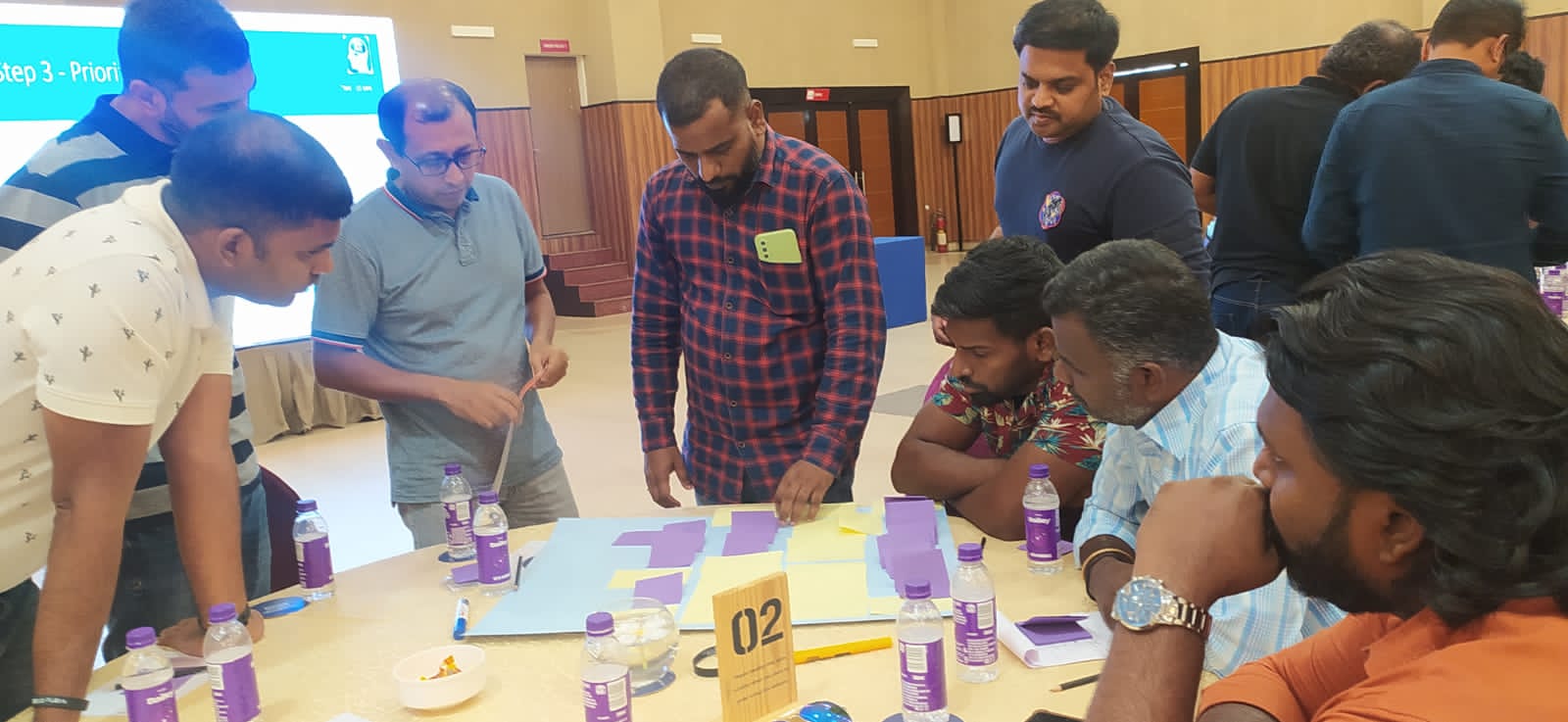
At a recent Creative Problem Solving programme in Hyderabad, one observation stood out. Participants did not struggle because they lacked ideas. The difficulty was moving beyond familiar ways of looking at a problem.
Once people were given the right tools, structure and space, the quality of the conversation changed. They explored possibilities before judging them, challenged assumptions and made their thinking visible through models and stories.
That experience reinforced a practical point: Creative Problem Solving is not a spontaneous burst of inspiration. It is a capability that teams can learn, practise and use on real work.
The first solution is usually the most familiar one
When a business problem is presented, teams often move quickly to the first workable response. This feels productive, particularly when time is limited.
But the first answer is often shaped by existing processes, past experience and untested assumptions. The team may be improving a familiar solution rather than exploring what the situation actually requires.
In the Hyderabad programme, participants first slowed down and examined the challenge from different perspectives. What did they know? What were they assuming? Who experienced the problem? What might be happening beneath the visible symptoms?
This did not delay progress. It created a stronger starting point.
A small change in framing can open new possibilities
One of the most useful shifts came through the use of How Might We questions.
A fixed statement can make a challenge feel narrow or predetermined. Reframing it as a question creates room to investigate alternatives.
Instead of asking, “How do we make the current process faster?”, a team might ask, “How might we help people complete this work with less waiting and fewer handovers?”
The second question does not assume that the existing process should remain unchanged. It directs attention towards the experience and the outcome.
Divergent thinking must come before convergent thinking
Many participants recognised that they usually begin evaluating ideas while they are still generating them. A suggestion is raised and immediately met with questions about cost, feasibility or past attempts.
Those questions matter, but their timing matters too.
Creative Problem Solving separates two modes of thinking. Divergent thinking expands the field by generating alternatives, making unusual connections and challenging assumptions. Convergent thinking then applies evidence, constraints and priorities to decide what deserves further development.
When teams mix the two too early, familiar ideas survive and different possibilities disappear before they can be understood.
What changed when participants started building
A significant part of the programme involved “thinking with hands” through LEGO-based facilitation led by my co-facilitator, Vishal Kapse.
Participants did not only discuss their ideas. They built physical models to represent how they understood a challenge, what was creating friction and what a better situation might look like.
The act of building changed the work in several ways:
- Every participant had something concrete to contribute.
- Ideas that were difficult to express verbally became visible.
- Metaphors surfaced relationships, obstacles and priorities that had remained hidden.
- Teams could point to specific parts of a model and ask better questions.
- Different interpretations of the same problem became easier to compare.
A physical model gave the team a shared object to examine. The discussion became less about defending a position and more about understanding what the model revealed.
LEGO was not used to produce the answer
LEGO-based facilitation is sometimes misunderstood as a playful ideation activity. Used well, it is more disciplined than that.
The bricks are a thinking aid. They help people externalise an idea, explain it through a story and revise it as new perspectives emerge. The value comes from the questions, reflection and shared meaning built around the model.
In practice, the models helped teams explore questions such as:
- What is the most important part of this situation?
- Which relationships influence the outcome?
- Where is the blockage or tension?
- What are we not discussing?
- What would need to change for a better outcome to become possible?
The method did not remove the need for evidence or business judgement. It helped participants reach a richer understanding before applying them.
Different models revealed different versions of the problem
When participants built individual models, they often represented the same challenge differently. One person focused on customer needs, another on process dependencies, another on leadership decisions and another on team confidence.
None of these views was necessarily wrong. Together, they revealed that the problem was broader than any single perspective.
Participants then used models, stories and visual thinking to create a shared view. This is where diverse perspectives became a practical advantage rather than a source of disconnected opinions.
From an idea to something the team can examine
An idea described in a sentence can sound complete while meaning different things to different people. Building a model forces greater clarity.
What exactly is changing? Who is affected? How do the parts connect? Where might the idea fail? What assumption needs to be tested first?
The model is not the final solution. It is a low-cost way to make an idea discussable, challengeable and improvable before the organisation invests heavily.
What should continue after the programme
The real value of Creative Problem Solving is not the number of ideas generated in a room. It is whether teams continue using better habits when they return to work.
Those habits include:
- Reframing the challenge before developing solutions.
- Separating facts from assumptions.
- Creating several options before selecting one.
- Making ideas visible through models, sketches or prototypes.
- Inviting different perspectives into the discussion.
- Testing an important assumption before making a large commitment.
Each habit is small enough to repeat. Together, they strengthen the organisation's ability to respond to unfamiliar and ambiguous challenges.
Better ideas come from better conditions
The Hyderabad programme was a useful reminder that creativity is not limited to a few naturally imaginative people.
People think more creatively when the work is structured to help them move beyond the obvious, when every voice can contribute and when abstract ideas become visible enough to explore together.
Creative Problem Solving is therefore not about producing one clever idea. It is about building a repeatable way to frame challenges, generate alternatives, combine perspectives and move promising possibilities towards action.
That is a capability an organisation can use long after the bricks are put away.