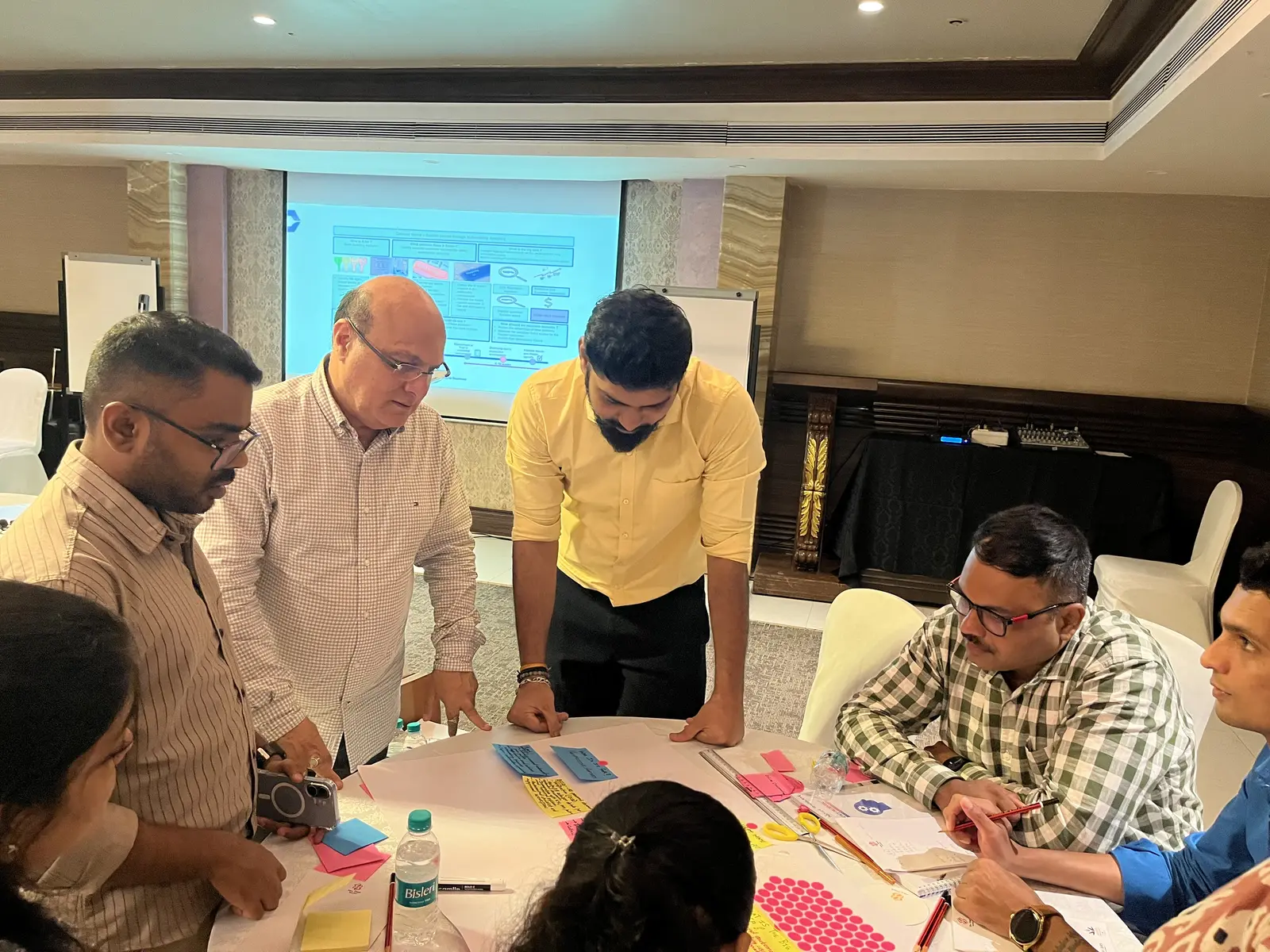
A well-designed workshop can change how a team sees a problem.
It can help people step away from familiar assumptions, understand the experiences of customers or employees, and explore possibilities they may not have considered before.
But a workshop is still only the beginning.
The real test comes afterwards, when teams return to their everyday environment. They must find time alongside operational priorities, work across organisational boundaries, gather evidence and convert early ideas into actions that leaders can support.
This is where coaching and mentoring can make a meaningful difference.
The challenge begins after the workshop
During a facilitated Design Thinking Lab, teams have structure, dedicated time and access to guidance. They can explore a live business problem, speak with users, identify insights, reframe the challenge and develop early concepts.
Once the workshop ends, that structure is no longer automatically available.
- Is our problem statement focused enough?
- Have we spoken with the right stakeholders?
- Are we interpreting the evidence correctly?
- Which idea should we develop further?
- What is the most important assumption to test?
- How should we present the proposal to leadership?
Without support, teams can lose momentum or move too quickly towards a preferred solution. The methods may have been understood, but applying them to a complex organisational situation requires judgement.
From understanding the method to using it confidently
Innovation capability is not built by remembering a set of tools. It develops when teams repeatedly use those tools to make better decisions.
A journey map is useful when it reveals an experience that needs attention. A prototype is valuable when it helps a team test an important assumption. An idea becomes relevant when it is connected to evidence, feasibility and a clear business priority.
Coaching helps teams understand not only what to do, but why it matters at that particular stage of the work.
The coach does not take ownership of the problem or provide the answer. The role is to ask the questions that help the team think more clearly, examine its assumptions and decide what evidence is needed next.
What 6–12 weeks of coaching and mentoring can include
Depending on the business priority and maturity of the team, Innovation Spark Asia can provide structured coaching and mentoring support for 6–12 weeks after a Design Thinking Lab.
Refining the challenge
Teams review whether the initial problem statement reflects the real need and whether the scope is practical. New research or stakeholder conversations may reveal that the challenge needs to be reframed.
Strengthening customer and employee insight
Teams receive guidance on interviews, observation, synthesis and the distinction between an interesting comment and a meaningful insight. This helps keep the work grounded in real experience rather than internal assumptions.
Developing and prioritising ideas
Coaching helps teams compare alternatives, identify trade-offs and select ideas that deserve further development. The focus is not on generating the largest number of ideas, but on identifying opportunities that are relevant, testable and connected to the intended outcome.
Testing assumptions through prototypes
Teams identify the assumptions that create the greatest uncertainty and design an appropriate way to test them. A prototype may be a storyboard, process flow, conversation, mock-up or small operational experiment. It does not need to resemble a finished solution.
Working through organisational dependencies
Many promising ideas depend on other functions, systems, policies or leadership decisions. Coaching helps teams recognise these dependencies early and engage the right stakeholders before the initiative loses momentum.
Preparing for leadership decisions
Teams strengthen their evidence, clarify the value of the proposed action and prepare a concise decision-ready narrative. The purpose is to help leaders understand the problem, the evidence, the proposed direction and the next decision required.
Coaching is not project management
Coaching and mentoring support should not replace ownership within the organisation. The team remains responsible for the work, the stakeholder relationships and the decisions.
Capability grows when people learn to navigate the work themselves, not when an external consultant completes it for them.
Not every engagement needs the same journey
Some priorities can be addressed through a focused Design Thinking workshop. Others need a longer applied journey involving research, experimentation, coaching and leadership reviews.
The right structure depends on the complexity of the business problem, the experience of the team, the number of functions involved, access to stakeholders, the evidence required for a decision and the organisation's readiness to test and learn.
We therefore begin by understanding the business priority and context rather than recommending a predetermined programme.
Building a repeatable innovation capability
The longer-term value of coaching extends beyond one project. As teams work through real situations, they begin to develop repeatable habits:
- Clarifying the problem before discussing solutions
- Looking for evidence instead of relying on assumptions
- Involving stakeholders earlier
- Testing ideas before making large commitments
- Making progress visible
- Asking for specific decisions from leadership
Over time, these habits strengthen the organisation's ability to innovate. The result is not only a better response to the immediate problem. It is a team that is more capable of approaching the next challenge with clarity, confidence and ownership.
From a workshop to meaningful action
A Design Thinking workshop can create energy, alignment and a new way of looking at a business problem. Coaching helps protect that momentum when the work becomes more complex.
By combining facilitated Design Thinking Labs with 6–12 weeks of coaching and mentoring, organisations can move beyond exposure to a methodology and begin building a practical capability for solving real business problems.