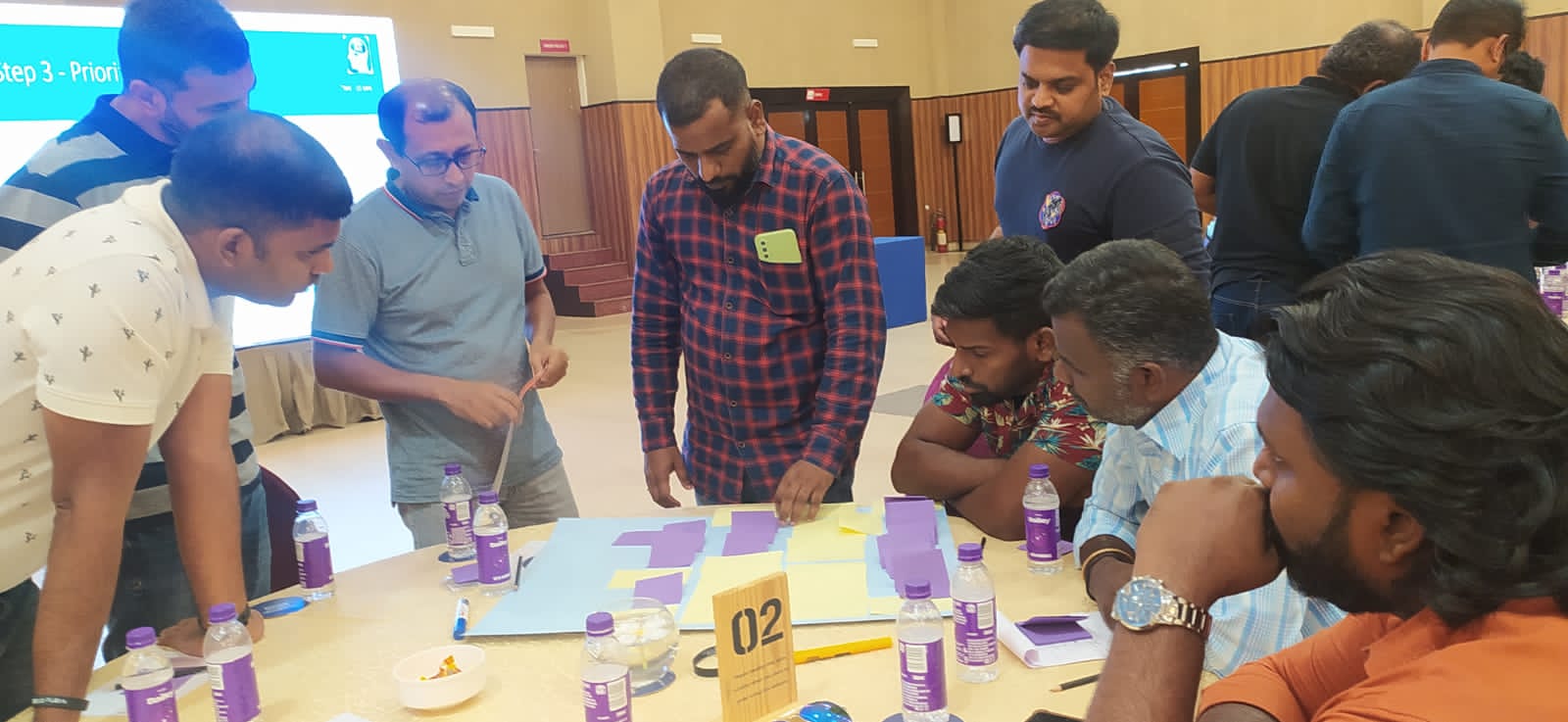
Many organisations want their people to become more innovative. They introduce frameworks, conduct workshops and encourage teams to think differently.
Participants often leave with new language, useful tools and positive energy. Yet the real test begins when they return to work.
Can they apply what they learned to an unclear business problem? Can they understand different stakeholders, challenge assumptions and work across functions? Can they develop ideas supported by evidence and move them towards action?
Innovation capability is not built by knowing the steps of Design Thinking. It is built when people repeatedly apply those steps to work that matters.
This is the purpose of the Design Thinking Labs delivered by Innovation Spark Asia.
A Lab is different from a conventional workshop
A conventional workshop is often designed around content. The facilitator explains a framework, participants complete exercises and the programme ends when the scheduled sessions are complete.
A Design Thinking Lab begins with a different question:
The challenge is not an example created for the classroom. It comes from the organisation itself.
It may involve improving a customer or employee experience, redesigning a process, reducing friction across a journey, strengthening cross-functional collaboration, exploring a new product or discovering where AI could create meaningful value.
Participants learn the approach by applying it to one of these live priorities. The learning and the business work happen together.
Begin with the problem, not the programme
Design Thinking Labs should not begin with a predetermined solution.
An organisation may initially believe it requires a new platform, a customer engagement initiative, an automation programme or additional training. These may eventually form part of the response, but they should not become the starting assumption.
The Lab first helps teams understand who experiences the problem, what is happening in their context, where friction occurs, what evidence is available and which assumptions are influencing the organisation's view.
This early work often changes how the challenge is understood. Better problem understanding prevents teams from investing too quickly in the wrong response.
Participants become practitioners, not spectators
Innovation capability cannot be developed through observation alone. People need to conduct interviews, interpret findings, make sense of conflicting perspectives and decide what deserves attention.
During a Design Thinking Lab, participants work through the complete challenge:
- Understand the context and intended outcome.
- Identify the people and stakeholders affected.
- Gather human and business evidence.
- Make sense of observations and patterns.
- Frame the underlying problem.
- Generate and prioritise possible responses.
- Develop clear concepts and prototypes.
- Test important assumptions.
- Present evidence and recommend the next action.
The facilitator provides structure, challenge and coaching. The participants do the thinking. This is what begins to build confidence and judgement.
Real problems create a different quality of learning
People behave differently when the challenge matters to their organisation.
They cannot rely only on the framework because the work contains real ambiguity. Stakeholders may disagree. Data may be incomplete. Customers may describe needs differently from what the team expected. Operational constraints may challenge an attractive idea.
Participants learn that Design Thinking is not a sequence of templates. It is a disciplined way to investigate uncertainty and make better choices.
The messiness is not a distraction from learning. It is an essential part of it.
Cross-functional teams see the complete challenge
Many business problems sit between functions. A customer journey may involve sales, operations, technology and service. An employee experience may involve HR, managers, systems and organisational policies.
Each function sees one part of the situation. Design Thinking Labs bring these perspectives together around a shared outcome.
The conversation starts to move from departmental positions to shared understanding, from assumptions to evidence, from explaining constraints to exploring options and from individual activity to collective ownership.
Leaders play an essential role
A Design Thinking Lab cannot create sustained progress if it remains disconnected from leadership.
Leaders help define why the challenge matters, clarify the intended outcome and give teams permission to investigate the problem honestly. They also help teams gain access to customers, employees, data and stakeholders or resolve dependencies that stand in the way.
At the end of the Lab, leaders should not simply attend a presentation. They should respond to the evidence and decide what happens next.
- What did the team learn?
- What changed from the original understanding?
- Which assumptions were tested?
- What evidence supports the proposed direction?
- What remains uncertain?
- What is the next decision and who owns it?
Prototypes make ideas discussable and testable
Ideas can sound promising while remaining open to different interpretations. A prototype turns the idea into something people can see, experience and question.
It may be a storyboard, redesigned process, customer journey, service interaction, sample communication, paper interface, role-play, concept poster or a small operational experiment.
The prototype is not intended to prove that the final solution has been found. Its purpose is to expose assumptions and help the team learn before the organisation commits significant resources.
Ideas need a clear path to action
A common weakness in innovation programmes is the gap between ideation and execution.
Innovation Spark Asia's Labs help teams move towards decision-ready action. A promising concept should make clear the problem, the people affected, the proposed response, the value it may create, the evidence gathered, the uncertainties that remain, the next decision and the owner.
Not every idea should proceed. Some should be adapted, combined, paused or stopped. The objective is to help the organisation make better-informed choices.
Coaching and mentoring help teams sustain momentum
Capability is not embedded through one workshop or one exposure to a framework.
The most difficult work often begins after the facilitated sessions, when teams must conduct research, interpret conflicting evidence, engage stakeholders, test prototypes and move their ideas through organisational decision-making.
During this period, teams receive practical guidance as they refine problem statements and research plans, interpret customer or employee insights, develop concepts, test critical assumptions, improve prototypes, navigate dependencies and prepare evidence-led leadership presentations.
The role of coaching is not to solve the problem for the team. It is to strengthen the team's ability to think, decide and act with greater confidence.
The duration and cadence are adapted to the challenge, the maturity of the teams and the intended outcome. Some engagements require focused reviews at key milestones, while others benefit from regular coaching throughout the journey.
This sustained support helps prevent promising ideas from losing momentum once the workshop ends.
Capability remains after the immediate problem
A successful Lab should produce more than a proposed solution. It should also strengthen how people approach future challenges.
Participants develop repeatable habits: starting with the people affected, separating observation from assumption, framing problems before developing solutions, listening across functions, testing before investing heavily, using evidence to influence decisions and owning the next step.
When these behaviours are used repeatedly, they contribute to a wider culture of innovation.
The Lab should fit the organisation's context
A GCC, a consumer-facing enterprise, a manufacturing organisation and an HR function may all require different applications of Design Thinking.
A GCC may focus on moving from execution to enterprise influence. A consumer business may prioritise customer experience or product design. A manufacturing organisation may need to bring customer understanding closer to technical teams. HR may use the approach to redesign employee experiences and people processes.
The method provides a common discipline, but the challenge, participants and expected outputs must reflect the organisation's business model and priorities.
That is why Innovation Spark Asia begins by understanding the business context and the capability the organisation wants to strengthen.
Building the organisation's capacity to solve
The long-term value of a Design Thinking Lab is not one workshop, one set of ideas or even one successful solution.
It is the organisation's growing capacity to approach difficult problems with greater clarity, confidence and ownership.
Teams learn how to understand before acting. Leaders receive stronger evidence for decisions. Functions develop a shared way of working. Promising ideas gain a clearer route towards action.
That is how Design Thinking moves beyond training. It becomes a practical organisational capability for solving real business problems and creating measurable progress.