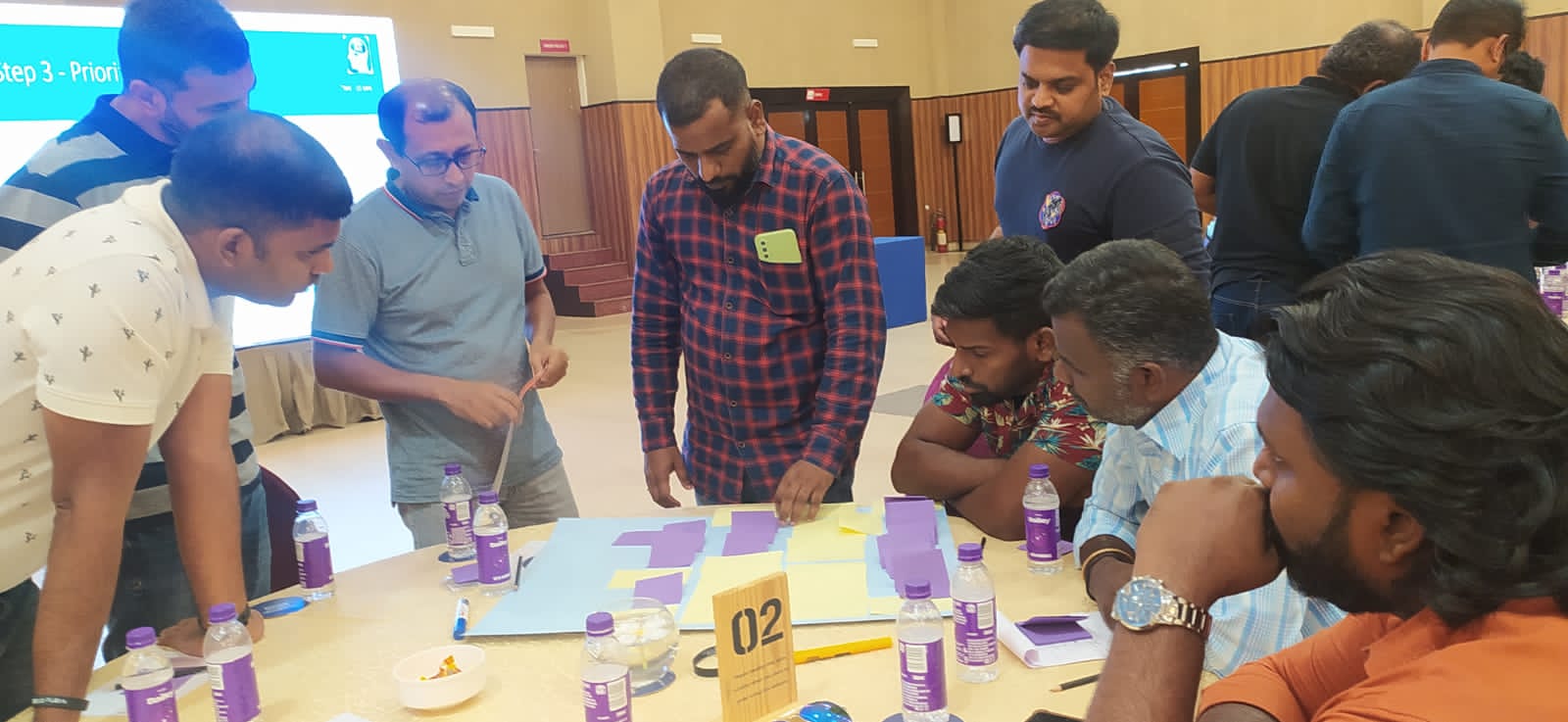
Search for a corporate Design Thinking workshop in India and you will find many providers, formats and promises. Some programmes are useful introductions. Others are designed to move a live business challenge forward. Buyers need to know which they are choosing.
1. Begin with the business priority
Before comparing agendas, define what needs to change. Is the organisation trying to improve a customer journey, redesign an HR process, identify a new opportunity, strengthen GCC influence or build a common problem-solving language? A credible provider should ask about the context before recommending a format.
2. Decide what level of outcome you need
An awareness session can introduce principles and vocabulary. An applied workshop can help a team frame a challenge and create concepts. A capability journey can include research, coaching, validation and leadership reviews over several weeks. These are different products and should not be compared only by duration or price.
3. Ask whether teams will work on live challenges
Simulations can make an introduction easier, but real work creates better learning. It brings stakeholder tensions, incomplete evidence, operating constraints and genuine decisions into the room. Ask how the provider will select, prepare and safeguard the challenges before the workshop.
4. Look beyond a list of tools
Empathy maps, journey maps, ideation methods and prototypes are useful only when they improve the quality of thinking. The facilitator should be able to adapt the process, slow the team down when assumptions are driving the answer and move it forward when enough evidence exists.
5. Assess the facilitator's enterprise experience
Corporate facilitation requires more than explaining a method. It involves working across functions, handling senior stakeholders, maintaining participation, connecting creative work to business realities and helping sponsors make sense of the output. Review the facilitator's profile, case studies and evidence from previous cohorts.
6. Clarify the outputs before the programme
A useful brief should state what the team is expected to leave with. Depending on the challenge, that may include stakeholder insights, a reframed problem, prioritised concepts, prototypes, testing evidence, owners and a decision-ready action plan. A wall full of ideas is activity, not an outcome.
7. Check who needs to be involved
The participant mix often matters as much as the agenda. Cross-functional challenges need the people who understand the process, customer, technology and commercial reality. A sponsor should establish the purpose, clarify boundaries and remain available for decisions without controlling the team's thinking.
8. Ask what happens after the workshop
If the intended outcome goes beyond awareness, follow-through should be designed from the start. Coaching, evidence gathering, prototype tests and sponsor reviews help teams turn promising ideas into informed decisions. Ask who owns each next action and when progress will be reviewed.
9. Examine evidence carefully
Participant ratings tell you whether the experience was relevant and well facilitated. Case studies indicate whether the provider can work with real organisational challenges. Neither guarantees your outcome, but together they offer a better signal than broad claims or a self-published ranking.
Questions to ask shortlisted providers
- How will you understand our context before designing the programme?
- What type of challenge is suitable for this format?
- What preparation is required from sponsors and participants?
- What will teams produce, and how will the quality of that work be assessed?
- How do you handle research or evidence that cannot be gathered in the room?
- What support is available after the facilitated sessions?
- What relevant enterprise or GCC work can you demonstrate?
How Innovation Spark Asia approaches the choice
We begin with a short exploratory conversation about the business priority. The answer may be a focused workshop, a multi-session lab or a longer capability journey combining facilitation, coaching and consulting. The programme is then shaped around the context rather than selected from a fixed catalogue.
Our corporate Design Thinking work is led by Ravi Kant and uses live business challenges to help enterprise and GCC teams create clearer direction, stronger evidence and focused action.